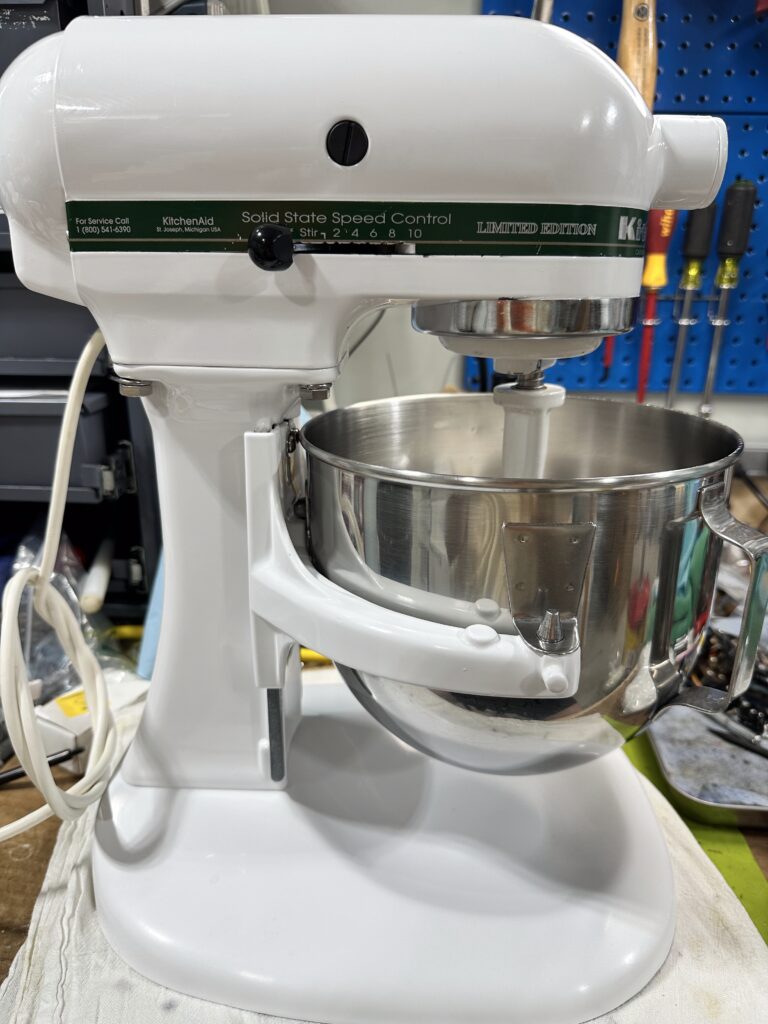
KitchenAid stand mixers are both heavy and fragile; this challenging combination of attributes makes it critically important that they be packed carefully for transit, whether in a moving truck or when being shipped.
By far the best way to ship a mixer is in the original factory packaging. The packing was carefully designed and engineered to protect the mixer and associated items (bowl, accessories, etc) from damage resulting from ordinary handling during common-carrier transit. (Pro tip: it doesn’t matter how many “Fragile” labels you slap on the box. I’ve spoken to UPS and FedEx drivers, and to a one — and independently — they say that such labeling doesn’t affect how the box is handled by the carrier.)
For this reason, I always recommend that you keep the box that the mixer came in, if space permits. Put it in a large heavy duty poly bag (I like Warp’s “Banana Bags” for this), twist the top shut, and tie a knot in it.
How to Get A New Factory Box
If you have discarded the original box, you can obtain a replacement for most models by calling KitchenAid’s “Repair and Return” line at (855) 845-9684 in the US. Explain to them that you need a box so that you can ship your mixer. Be very clear that you only want the box — you’re not sending it in to KitchenAid for repair. Otherwise they will charge you a diagnostic fee.
They may take your order over the phone, or ask for your email address and will email you a link to a form that you can fill out to order the box. If they do the latter, make sure to check the “BOX ONLY” box on the form.
Either way, have your mixer’s model number and serial number handy, from the label under the base. This will ensure that you get the correct box for your mixer.
Note: As of this writing, KitchenAid no longer has boxes available for the K5-type machines. This includes the K5-A, K5SS, KSM5, and other 5-quart bowl-lift models which have a round rear cover secured by a screw at the top.
In addition, KitchenAid will not supply a box for the Accolade 400 or for any of the vintage machines (3B, 3C, 4C, etc). For those you are on your own.
How To Pack A Mixer
These are the instructions that I provide to customers who are shipping K5-type mixers to me for repair, and which I follow when packing a mixer for return to the customer after the job is done.
Note: These instructions apply only to models for which the factory box is no longer available. Whenever possible, get the factory box from KitchenAid or use the one you have.
I have written these instructions for K5 machines, because that is the most common situation which requires packing it yourself. These may be adapted for the Accolade 400 or smaller vintage machines.
Things you’ll need:
- A shipping box, heavy duty, no larger than 20 x 20 x 20 inches.
- Foam insulating board or “plank foam”.
- Bubble wrap (with large bubbles). Do not use Amazon air pillows or anything similar; they will pop and leave the mixer unprotected.
- A pool noodle. A length of water pipe insulation (3/4″ ID) is acceptable.
The factory shipping box for K5 machines is 13w x 15d x 20h, so you will need a heavy-duty shipping box that is at least that big in each dimension. 18x18x18 is too small, 20x20x20 is ideal. 24x24x24 is too large and will incur significant additional cost. You can improvise with an existing box if necessary, as long as it is heavy duty and of the proper dimensions. Don’t use a repurposed Amazon shipping box; they are too flimsy to provide proper protection.
If you are shipping a smaller machine such as an Accolade or 4C, you can reduce the size of the box correspondingly. Just make sure that there is at least two inches of clear space around the mixer on all six sides, in order to make room for the foam walls.
Whatever you do, DO NOT USE PACKING PEANUTS. I cannot emphasize this enough. They will shift and leave the mixer unprotected in the box. This will result in irreparable damage to irreplaceable parts. (I am aware that many packing experts use packing peanuts. They can do so because they know how to settle them properly so that they don’t shift.)
It should be possible to buy a shipping box at Staples, Home Depot or Lowe’s. Make sure you look for a shipping box, not a moving box. Moving boxes are not as strong as shipping boxes and generally get destroyed by most package handlers.
At Home Depot, Lowe’s, or a similar store, buy sheets of 1-inch insulating foam (it resembles Styrofoam and in fact usually is). You’ll need to use a razor knife or a fine saw to cut pieces to fit into the box. Make sure that there are at least two full layers of foam on each face of the box (top, bottom, and four sides) for a minimum foam thickness of two inches on each side. If you have a bigger box, use more foam layers. “Plank Foam” is ideal for this, but is harder to find.
Once you’ve lined the box with foam:
- Cut two pieces of pool noodle, each long enough to cover one arm of the bowl cradle. Then push a piece of pool noodle on to each arm of the cradle.
- Put the mixer in a plastic bag (a garbage bag is fine; anything that completely encloses the mixer to keep leaked oil from getting on the packing fill).
- Set the mixer in the box, placed in the center so that there is equal space all around.
- Fill ALL of the space around and above the mixer with bubble wrap. Pack in enough material so that the mixer can’t move around in the box, at all. DO NOT USE PACKING PEANUTS AS SPACE FILLER. You can also use brown packing paper (the same stuff that Amazon uses). Really stuff it in there – it will take more than you think.
- When you’re finished, make sure that the mixer doesn’t move around inside the box at all. It’s crucial that the mixer not shake, wiggle, wobble, shimmy, slide, or glide inside the box, since collisions with the side of the box are what cause the most damage.
- Put the top layers of foam on top of the mixer, and seal up the box. (You may have enough fill that you need to press down slightly to close the top, but not so much that it bulges.)
If you use a pack-and-ship place for this, make sure they follow the above guidelines: heavy duty shipping box; at least two inches of hard foam on all sides; pack the mixer in so that it can’t move, and NO PACKING PEANUTS. If they have a foam-in-place machine that is ideal, but not many places do. Either way they will charge you for the time and materials required to pack it.
Seal the box with a high-quality packing tape intended for shipping. (Some tape is labeled for moving and storage; don’t use this. Also don’t use duct tape.)
When this is done, the mixer is ready to ship. The bowl and accessories (beater, dough hook, wire whisk) can be shipped separately, if needed.
When packed this way, your mixer has the best chance of making the trip safely, without costly damage to irreplaceable parts.
My repair rates include UPS Ground shipping, so if you are shipping a machine to me, I will provide a prepaid UPS Ground shipping label for you to use.
If you are shipping your machine somewhere else. I recommend using PirateShip to compare rates and see which service has the best rate for you. (You can also create an account and generate shipping labels. You’ll need the weight and dimensions of the box.) UPS and FedEx ground service are both good; USPS may be the only alternative in some locales, but their rates are often remarkably high in comparison to the others.